
As technology continues to advance, many farming practices are becoming more efficient and productive. Agricultural drones, or “UAVs” (also known as Unmanned Aerial Systems), are becoming popular tools for crops to be sprayed and monitored, to create detailed maps of fields, and to be managed with precision in agricultural “farming 2.0” projects.
But, how accurate are agricultural drones in spraying and monitoring of fields?
The accuracy of agricultural drones in crop spraying depends on many factors, such as the drone’s navigation system and sensors, the flight plan, weather, crop type and size as well as the experience of the pilot/ operator. But with the right setup, they can spray crops precisely and generate very accurate maps and information from above the fields while minimizing waste.
In this blog, we will explore how a drone can be useful for both spraying and monitoring in agricultural fields.
What Makes Agricultural Drones Accurate?
Drones in agriculture are often equipped with GPS navigation, cameras, sensors, flight control systems and also special software. Together they enable the drone to fly along a pre-planned route and to gather data on specific parts of a field.
GPS navigation enables the drone to follow the set route. Furthermore, the automated system for control of speed and altitude is highly relevant in case of large agricultural surfaces and ensures a constant application rate.
For crop monitoring, the agricultural drone uses high-resolution and special cameras to take photos from above. How accurately these photos can be used for crop monitoring depends on the quality of the drone’s components and how one uses the collected data.
How Accurate Are Agricultural Drones in Crop Spraying?
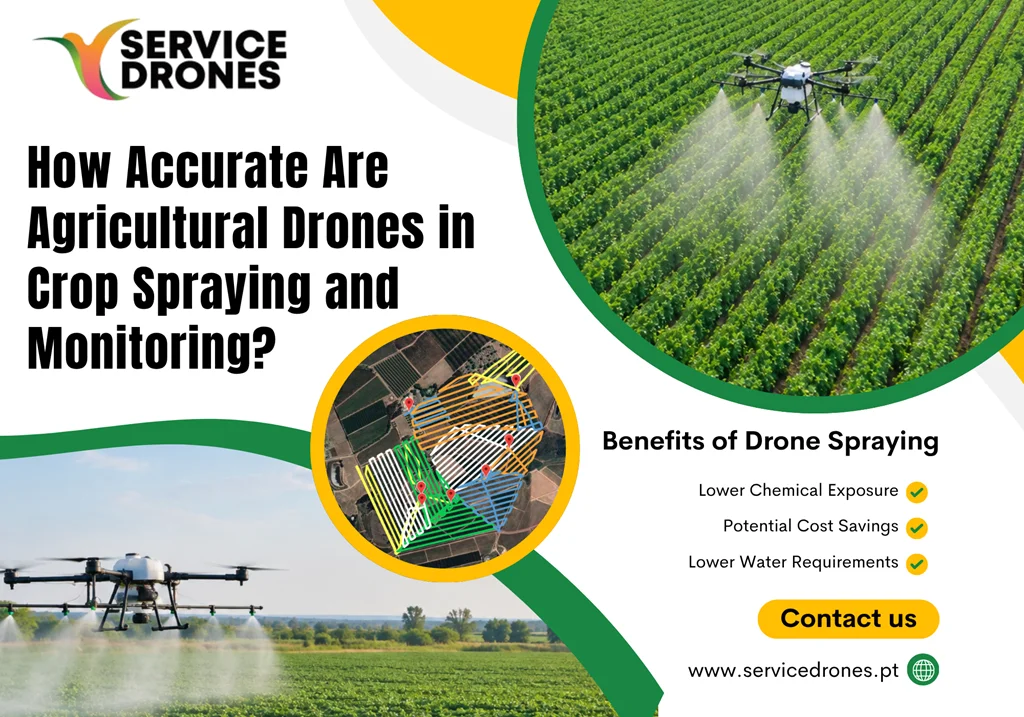
By equipping agricultural spraying drones with appropriate equipment, very targeted spraying can be executed. In this way, drone spraying in Portugal is becoming a practical option for agricultural operators looking to apply treatments more precisely while reducing unnecessary product use.
Agricultural spraying drones can provide very precise treatment by adjusting the following parameters: flight height, speed of flight, type of nozzle, volume of spray liquid used per unit area and drop size.
They are also very precise, and can help prevent unnecessary use of plant protection products by spraying specific parts of the field using a map or other information about the field.
Environmental factors can affect the spraying of a crop such as strong winds which can cause spray drift. Temperature and humidity also need to be taken into account as they can affect the behavior of the droplets. Spraying must therefore take place in suitable environmental conditions and with due observance of proper practices.
How Accurate Are Drones for Crop Monitoring?
Monitoring crops is another interesting area where agricultural drones can be of added value. Instead of walking long rows of crops, farmers can use drones to take aerial photos of large parts of their crop within a short space of time.
From these images a great deal can be learned about the crop in terms of its growth, density, water stress and possible damage. The aerial perspective provides an excellent overview of large areas of crops enabling farmers to focus on a specific area where problems may exist. This information cannot be seen in normal photos. The data collected by the sensors of the agricultural drone can be very valuable for the crop management of the farmer.
While the images captured by the drones can reveal serious problems in your crops, it is not a tool for farmers to solely rely on. Problems detected by the drone imagery would need to be further investigated on the ground in order to determine the cause or extent of the problem.
What Factors Affect Drone Accuracy?
Weather is an important factor to be considered. Wind could cause the sprayed liquid to deviate from the set spraying pattern and this could lead to drift. Weather such as rain could also affect the effectiveness of the spray application.
Drone equipment must be properly configured for correct application and field inspection. The quality of the drone’s camera or sensors, and the way in which they are processed, also needs to be sufficient to obtain quality information from the images and to convert them into useful information for monitoring.
Last but not least, operator experience also matters greatly. Even though drones can fly autonomously using pre-set paths, experienced human operators are required to plan and execute a mission and monitor developments during the process.
Agricultural Drones and Traditional Farming Methods
Agricultural drones need not replace all farming methods. Many agricultural drones can be used in conjunction with current farming methods to improve farming efficiency.
For monitoring purposes, the drone can show where attention is required and after that the farmer can do a targeted ground inspection instead of checking the whole field.
Spraying can be done in areas where conventional methods are impossible to use due to crop, terrain or field conditions.
In terms of applicability, it will depend upon crop type, field size, soil/terrain type, weather conditions and the individual farming task required.
How Service Drones Can Help
Service Drones offers a wide variety of professional drone services in Portugal to support companies as well as agricultural operators to monitor crops, make maps of fields and spray crops with precision.
Such services not only provide agricultural professionals with suitable equipment for the job at hand, but also plan and execute the appropriate flights in order to generate the greatest amount of practical use from the drones.
When selecting a drone solution, it is essential to select the correct drone in relation to the crop and field for which it will be used. Furthermore, professional planning and operation are necessary to achieve optimal results by agricultural drones in crop spraying and monitoring.
Conclusion
Service Drones can achieve high accuracy when the right agricultural technology is properly selected, configured, and operated. Using GPS navigation, drones can follow automated flight plans while advanced cameras and sensors collect detailed crop data.
However, accuracy also depends on factors such as weather, flight altitude and speed, nozzle configuration, sensor quality, field mapping, system calibration, and pilot expertise.
When these factors are managed correctly, Service Drones can support precision agriculture by monitoring crops, identifying areas that need attention, and applying treatments accurately. This helps farmers make better use of agricultural drones in crop spraying while improving efficiency and precision in crop management.