
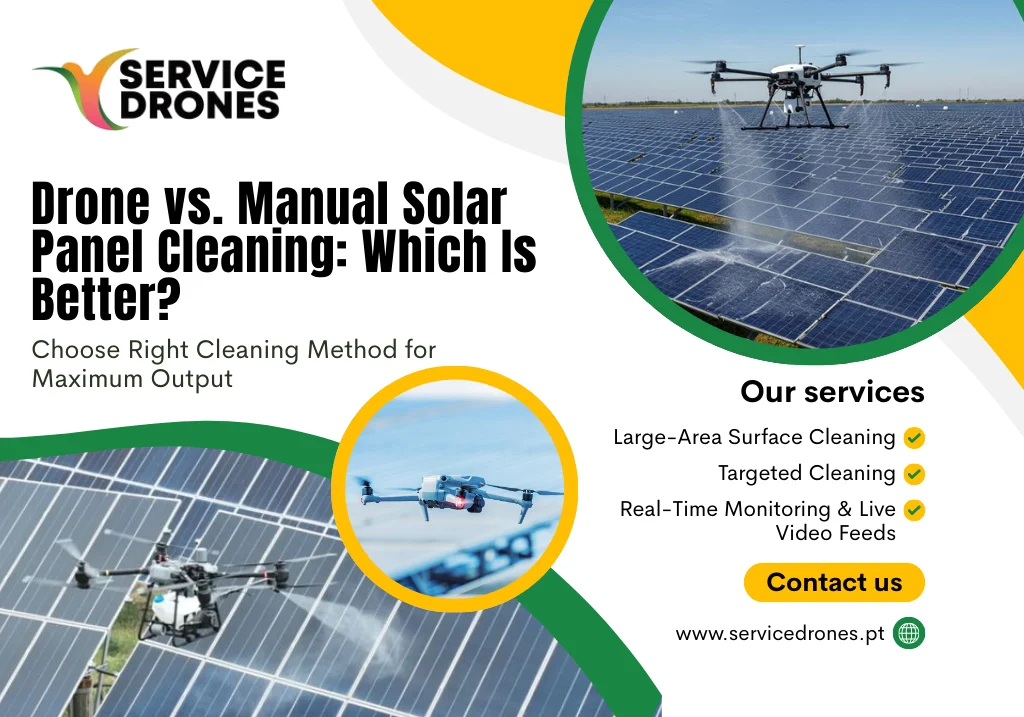

As more people begin to explore the use of solar panels as a source of renewable energy, there will be an increasing demand for ways to effectively maintain their solar panel systems.
Many are curious as to whether they should opt for cleaning their solar panels by hand, using a “bucket and sponge” approach, or if new technology, such as autonomous, drone-powered cleaning, can become an effective alternative to the manual methods.
What may come as a surprise to some is that unmanned aerial vehicles (UAVs) have the potential to compete with manual methods used to wash solar panels.
In this article, we will examine both techniques compared to each other and demonstrate how drones are revolutionizing solar farm maintenance. You’ll begin to see one method surpassing the other.
The Importance of Solar Panel Maintenance
The solar panels have to be cleaned, but why do solar panels need cleaning?
Just like any other fixture on your home, solar panels experience wear and tear.
From an accumulation of dirt, grime, pollen, bird droppings and just about any other type of debris you can think of, your solar panels will suffer from inefficiency.
Studies have found that when solar panels get dirty, they can lose up to 15-25% efficiency in energy production.
As a result, cleaning solar panels is not merely beneficial, but is necessary to maximize the return on your investment in solar.
Manual Solar Panel Cleaning: Traditional but Limited Manual
Manual cleaning has been the traditional method of cleaning solar panels. It involves having a technician access the roof (or elevated platform) and manually wiping down each panel using water, a brush and special cleaning solutions.
Advantages of Manual Cleaning
There are many benefits of manual solar panel cleaning, especially for small installations and easily accessible areas where hands-on cleaning is possible.
Instantaneous Visible Results: The technicians can visually observe the cleaning as it occurs and know whether they are covering all panels thoroughly
Ability to Inspect Panels Closely: While cleaning, the technicians can physically inspect each panel for cracks, broken glass, broken wire, or other types of damage requiring repair.
Small System Accessibility: An easy-to-use and cost-effective system for small residential installations having less than five panels and very accessible roofs.
No Specialized Training Required: Most service providers have enough training to do manual cleaning without additional training or certifications from special operators.
Flexibility: With direct human observation, there is flexibility for the technician to make decisions on how to proceed during the cleaning process
Flat or accessible roofs: Manual washing may be cost-effective for small residential systems where the roof is easily accessible.
These advantages make manual cleaning a suitable choice for small-scale solar cleaning with easy access.
Disadvantages of Manual Cleaning
Manual cleaning is a traditional method, but it can be time-consuming, costly, and risky, especially for large-scale solar panel cleaning.
Dangerous work environment: Technicians are often working off the ground and face serious injury. Roof falls are one of the leading causes of occupational injuries.
Liability & Insurance: Liability issues can increase insurance premiums.
Time-Consuming and Labor-Intensive: There is a lower ceiling on how many solar panels can be cleaned per day (20-50 panels/day).
Too expensive for large arrays: Cleaning and maintaining hundreds, if not thousands, of individual solar panels can become cost-prohibitive.
Can damage solar panels: Using the wrong chemicals or cleaning techniques can damage solar panels.
Deferred cleaning: If the cost to clean solar panels is too expensive, owners may go longer between cleanings. This can severely affect the efficiency of solar panels.
Dependent on weather: Cleaning solar panels can’t be performed in the rain, during high winds, or sometimes in extreme temperatures.
These are some of the key advantages and disadvantages of manual solar cleaning, but if we talk about large-scale solar panel cleaning, then it becomes risky, expensive, and time-consuming. Therefore, many owners are now looking for smarter and more advanced cleaning methods.
This is where modern technology comes in, like drone-based solar panel cleaning.
Drone Solar Panel Cleaning: The Modern Solution
Drone technology has transformed the way solar panel maintenance is performed. Solar panel cleaning with drones is safer, faster and more affordable than traditional manual methods, and also reduces the risk for workers.
How Drone Cleaning Works?
Drones equipped with specialized soft-brush cleaning systems for remote operation or as autonomous units can be used to clean debris off solar panels without damaging the panels.
In addition, drones are able to systematically map larger installation areas in order to provide an even level of cleaning on all panels.
When using a drone to clean a panel, it is common practice to have the drone hover over the panel so that it can spray deionized water onto the panel as it cleans with its rotating brushes to gently remove dirt and debris from the surface of the solar panel.
Advantages of Using Drone Cleaning Systems
Solar panel cleaning using drones provides faster, safer and more effective maintenance, especially for large solar farms and complex locations.
Safety: Drone technology eliminates the risk of technicians being injured by working at heights. Many organizations will replace their current method of cleaning with drone cleaning simply due to the safety of their employees
Efficient and Fast Cleaning: A drone can clean 200-400 panels per day, which is significantly faster than manual cleaners who can only clean 20-50 panels per day. A job that could take a crew of manual cleaners several days to complete could be accomplished by a drone in just a few hours
Cost-Effective: Although there are initial costs associated with implementing drone cleaning systems, they will ultimately reduce labor costs as a result of reduced labor needs. The savings of a large-scale commercial solar panel cleaning system become substantial over time
Consistent and Frequent Cleaning: Drone cleaning systems provide a way for property owners to perform regular, but less expensive, cleaning of their panels, which helps to optimize panel performance and prevents excessive losses of efficiency
Low-Risk of Damaging Panels: Drone cleaning systems are much gentler on solar panels than manual scrubbing or pressure washing because they use soft-brush systems and do not have personnel walking on the panels. The pressure used to clean the panels is also controlled
Inspection Data: Modern drones collect high-resolution images while cleaning panels, making solar panel inspection with drones provide detailed documentation of each panel’s condition and assist with identifying potential problems prior to major failures occurring
Accessibility: Drones can access difficult-to-reach locations such as very steep roofs, tall buildings or other remote locations where manual cleaning may not be safe or possible
Eco-Friendly: Many drones utilize deionized water and eco-friendly cleaning products to minimize environmental harm resulting from harsh chemicals used for cleaning
Scalable Operations: Drone cleaning systems allow companies to easily increase their operational capacity to clean large solar farms or multiple properties without incurring the same amount of increased labor costs
These advantages clearly show how drone cleaning systems improve safety, efficiency, and performance in solar panel maintenance.
Disadvantages of Drone Cleaning
As there are many benefits of solar panel cleaning with drones, but it also has some disadvantages you should know about, such as
High Initial Investment: Buying & storing drone equipment can come with hefty up-front costs.
Requires Training & Certification: Cleaning drones must be piloted by trained and certified drone operators who know solar panel cleaning best practices.
Weather Dependent: Cleaning drones cannot fly in high winds, rain, thunderstorms or other extreme conditions.
Inspection Limitations: Drones can take pictures but can’t perform up-close and personal inspections like your typical ground-based worker.
Aviation regulations: Drone companies must be certified and receive airspace clearance to operate drones.
Not cost-effective for very small residential systems: Drone cleaning may not be the most cost-effective solution for very small systems.
There are huge advantages of drone solar cleaning compared to the disadvantages. Many solar owners are now seeking professional drone service providers for safe and efficient maintenance.
Service Drones: Excellence in Portuguese Solar Maintenance
If you are looking for professional drone solar panel cleaning services in Portugal, look no further than Service Drones.
Service Drones is the premier provider of drone services in Portugal. We use advanced technology and highly skilled operators to provide you with the best results.
Our drone solar panel cleaning services are quick, safe, and environmentally friendly. We provide service to both residential and commercial customers all across Portugal.
Our operators are trained professionals who are certified in drone operation and solar knowledge.
We have the latest technology specifically made for cleaning solar panels. We also document the condition of panels.
Conclusion: The Clear Winner
Manual cleaning has been done for decades, but drones are obviously much more effective for the majority of use cases. Safer, more efficient, cost-effective and with less risk of damage to your panels, drone cleaning is the way of the future.
If you own a solar array in Portugal, don’t hesitate to reach out to a professional drone cleaning service, Service Drones and we’ll have your system running at optimal efficiency.
Make the switch to drone cleaning and keep getting the most energy production out of your investment while keeping your workers safe.